Core Capabilities
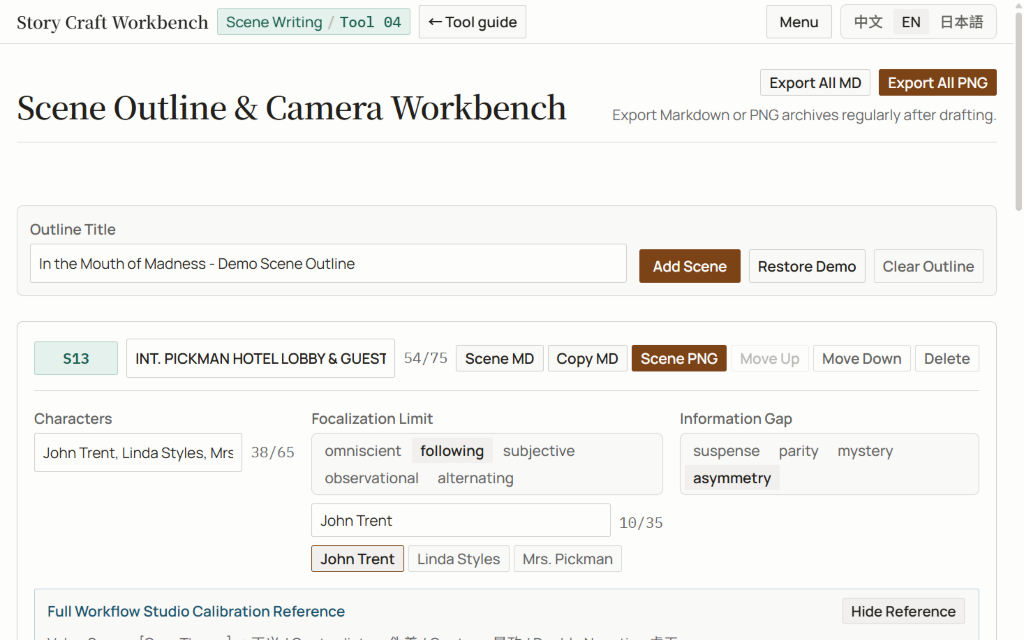
- Scene header binds 5 focalization limits and 4 information gaps (suspense, parity, mystery, asymmetry), with silent Beat inheritance or explicit handoff-motivated overrides.
- Full-width Scene Objective plus three aligned methodology panels warn when starting and ending value poles stall unchanged, while optionally surfacing read-only references from the Workflow Studio.
- Typing /cam or clicking Insert Camera opens a non-modal phrase picker supporting multi-dimensional progressive, alternating, and jump combinations plus 9 intent presets modulated by active L1 baseline.
- Exports clean single-scene or full-project Markdown alongside crisp multi-page Canvas PNG sheets that wrap CJK and Latin text without splitting lines or chips.
Underlying Methodology
Camera placement is not decorative garnish after writing: whose eye we borrow, how tight the scale presses, and who gets crowded by a shoulder decide whether the Value Gap hits emotionally and whether hidden stakes leak early.
- 01 Value: Five-Step Scene Audit & the Gap
- 02 Emotion: Empathy Calibration & Pathologies
- 03 Information: Dramatic Exposition & Line Audit
Theoretical References
- Silas Xu, Storycraft Guide: Value Square poles, empathy calibration and craft pathologies, dramatic exposition rules, and the three-question line audit
- Gérard Genette focalization limits (omniscient, following, subjective, observational, alternating) and Audience-Character information gaps
- Core cinematography 6-scale framing, camera angles, 180-degree axis rules, and anime storyboard kamite/shimote staging conventions
- Screenplay implied-shot discipline keeping technical brackets short, visual, and subordinate to visible action
Getting Started in Three Steps
- Explore the preloaded In the Mouth of Madness (S13 & S29) sample scenes to see scene-level methodology ledgers flow into Beat-level action and camera chips, or clear to start fresh.
- Lock the scene focalization limit, bound character, and information gap, then fill Value Shift, Emotion Target, and Information Design before drafting beats.
- Draft beats line by line, invoke /cam at turning points to attach concise camera phrases with live conflict checks, and export Markdown or PNG pages for your archive.